Wednesday, 5 September 2012

THESE ASSOCIATIONS - TINO SEHGAL TURBINE HALL COMMISSION


Along the balcony overlooking the Turbine Hall in London's Tate Modern, a group of people are stood watching the space below. This in itself isn't surprising - the balcony is a commonly used vantage point for finding lost friends and for people-watching. But there is something noticeably different about the dynamic between the bodies in the Turbine Hall; something out-of-the-ordinary about the way that they move and interact. Whilst some of the figures below appear to be making a more routine visit to the gallery, others amongst them have different intentions: they clumsily dance around one another, stopping and starting, lightly jogging in different directions, without any immediately evident pattern. Their individual journeys begin to synchronise, and all at once a mass of these people are speeding toward the main entrance. They pause and run back down the slope.


This is Tino Sehgal’s These Associations, a piece developed in response to the Turbine Hall commission. A group of people – it is unclear how many – perform a choreographed piece in the public space. They have no costumes and no stage, and there is no clear distinction between performers and audience. Sometimes they move with purpose, other times apparently randomly, as free agents. (This reminded me of how Carolee Schneeman had described in her talk at Summerhall how dancers had always been to her 'like particles of energy in space’). They don’t talk, and their faces are impassive. Watched from above, the rhythms and patterns made between their bodies are like those of rippling water, or shoals of fish. The runners’ mass exodus up and down the slope is like the sea tide; at points, participants run circles around visitors, catching them in a whirlpool of bodies.

Each of the ‘performers’ are in their own clothes. As they jogged past, I recognised one among them as the man who shared my bench outside the gallery while we both separately ate our supermarket lunches. A lunch break for Sehgal’s artwork. How easy it must be for these people to break themselves off from piece and melt into the regular crowd - their status is defined by their behaviour only. The work probes our definitions of identity and the division between art and audience.

 At one point an intermixed crowd of performers and viewers gathers at the base of the main slope. They chant, then sing. WE HAVE CHANNELLED CHANNELLED CHANNELLED CHANNELLED THESE FORCES INTO THE WORLD WE HAVE CHANNELLED THESE FORCES INTO THE WORLD. Their voices rise in the gallery space to an echoing, glorious crescendo before stopping abruptly. Slowly, figures pick themselves from the main group. On either side of me were two men – each were approached by a figure from the group and apparently launched into a one-way conversation. The woman to my left spoke closely and intimately to her chosen listener; on my right a girl in her twenties plunged into her own story: ‘It was the end of the bread, you know? So I thought, okay, it’s night-time, and I wanted it toasted yeah? I found some jam, spread it on thick, thick layers right? And it was like, the most satisfying thing’. While they are talking, the others slowly walk backwards into the dimly lit opposite end of the Turbine Hall, having divulged their own strange secrets to members of the public.


Adrian Searle has described in The Guardian how, during this brief moment of confession, the dynamic is changed between himself and these people, before ‘they’re off again’. But I think that this feeling isn't restricted to this one moment; the dynamic changes as soon as we recognise the figures as behaving differently to ourselves. We notice them properly. We scrutinise our co-inhabitants of the Turbine Hall to discern whether or not they are part of the piece. Something in wanting to connect with and understand the people around us shifts to the positive.

For this, Sehgal’s piece is remarkably successful in its reinvigoration of the social dynamic of the space and the way in which it encourages us to look again at each other, and at ourselves. Sehgal has requested specifically that there be no ‘explanatory’ text or literature for the piece, ostensibly in an effort to keep it as ‘live’ as possible and retain focus solely on social connections in the present. In this, the artist has set up a situation and departed from it – one thing you don’t want to ask the people involved is ‘What’s it like working with Tino Sehgal?’ – instead ‘What’s your story?’ and ‘How did you get involved in this?’.

The artist is giving a talk at the gallery on Saturday 6th October, in conversation with Tate curator Jessica Morgan. I am tempted to go but doubt the artist will enlighten us to anything that would change or ameliorate a direct experience of These Associations. The work will be in the gallery until 28th October. I'll definitely be back.


Tuesday, 4 September 2012

NOT SO GREAT BRITISH ART DEBATE

An insight to the inner workings of the minds of the Great British Public, as displayed on the communal feedback board in Tate Modern's new space The Tanks. Quite incredible - this selection is pretty representative of the comments left, most of which demonstrated the same level of engagement with the gallery and its collection...Up your game, Tate! A new method of gathering feedback needs to be developed!


Monday, 3 September 2012

THE IMPORTANCE OF SEEING


Andrew Miller's The Waiting Place is not, truly, much of a waiting place as it doesn't include anywhere obvious to sit. But although we may not be encouraged to rest there, in making the seemingly pointless journey through the structure we are made to consider its physical properties more closely - as, in fact, we might do anywhere we are forced to wait.

The through-way of the wooden construction contains no interior event, but for a tree which seems to burst through its roof. It is as if the tree has grown into the structure and through the cast iron roof panels that have been cut roughly to accommodate its branches. There is thus a sense that the structure could have occupied the space before the tree, were we to fabricate our own imagined history of the site. This idea corresponds to the strange timelessness of the architecture - the overlapping cantilevered roof planes suggesting simultaneously Japanese pavilions and primitive huts, whilst the planks of dark wood are arranged in such a way to suggest something of the linearity of Frank Lloyd Wright's domestic designs and his use of textured materials. But these were only my thoughts while I was waiting.


 Today, The Waiting Place, along with all of the wonderful site-specific public installations which formed part of the Edinburgh Art Festival programme, is closed. August is over and we must wait another year for it to come around again. Freshly back in London, and with far fewer exhibitions under my belt as I would have liked (a month of double shifts at the bar-then-burgervan would have proved too taxing I hope even for the most enthusiastic of gallery-goers) I am reminded how important it is to see such works in the flesh. No artist's impression or photograph can come close to conveying the direct experience of a work and the thoughts and personal associations it might provoke.
The 'artist's impression' in the Edinburgh Art Festival programme was far from the reality of the finished installation

Saturday, 11 August 2012

THEATRICAL LIFE DRAWING / DRAWING THEATRE: AN AUDIENCE WITH HENRIETTA MORAES


Still Life: An Audience with Henrietta Moraes calls itself ‘a play interweaving text and drawing’. This will presumably appeal to a mixed crowd, who might be divided by their predominating interest in either of these interwoven components. The pull for me, of course, was the drawing  - an hour’s life-drawing for a fiver? Yes please.

Sue MacLaine, originally starting out as a stand-up comic, devised the script for the play which has her speaking as Henrietta Moraes, a ‘bohemian’ of the London hippie scene, friend to Francis Bacon and Lucien Freud. MacLaine delivers a great performance and the script is poetic and at times quite beautiful; her voice chimes over the fervent scratching of pencils and charcoal as she moves deliberately and gracefully between poses.

She often addresses the audience directly – ‘this is a Bacon story, you’ll like this’ – and makes direct eye-contact with her audience as they are drawing, making for a different kind of drawing experience to that which normally takes place in the studio. The piece sets up a curious dynamic between the audience and performer: in actively participating in the show the drawers are able to imagine a more personal relationship with the model, and in turn, themselves as the artists she speaks on on that London scene.

I would thoroughly recommend MacLaine’s piece at Whitespace to both those who can and cannot draw, and to those who have and have not tried life drawing. I found myself switching in and out of the narrative as I drew – Still Life: An Audience... is a multifaceted piece of theatre which can be experienced on different levels.

Go watch, listen to and draw Sue Maclaine as Henrietta Moraes at Whitespace on Gayfield Square, until 27th August.


Thursday, 9 August 2012

SCHNEEMANN @ SUMMERHALL

'Contents of this lecture are a well-guarded secret!' warned the Summerhall programme. What would the 73yr old Carolee Schneemann, pioneering feminist artist, cat obsessive and general eccentric, deliver in her ‘performative lecture’ in the converted vet school? 

We take our seats in an authentic lecture theatre, lines of desks still intact with hard backed seats to keep students upright in some of the more soporific lectures. The lights go down; Gnarls Barkley's 'Crazy' comes over the stereo. And here she is, with a mass of white hair luminous before the light of the projection lamp. Clutching a knobbly branch and purposefully-nonchalantly waving a rope at her audience, she slowly descends the staircase between the desks. Has she finally lost it? No one is quite sure what to make of this slightly bizarre entrance. She reaches the stage. 'Okay, I'm in control.' she says with a mischievous half-smile. And so we are introduced to the artist’s curious and unique wry humour which lightens even the darkest subject matter. Over a career of over forty years, Schneemann’s work has addressed less than palatable issues: the falling figures of 9/11, animal abuse, and themes of gender identity which she acknowledges can be ‘hostile and aggressive’ but she twists to make them ironic: ‘I can’t be cynical.’


Schneemann’s talk was engaging, lively and personal. She discussed the iconographical importance of less obvious motifs beyond the commonly identified themes of gender identity and sexuality in her work, beginning with what she called ‘predictive drawings’ from childhood. The staircase for example is important for the moment of 'gravitational uncertainty between steps'; the cat serves as a 'central form of narrative' that 'defines space' and serves as a symbol of 'comfort and intra-species communication'. 'It's really well done don't you think?' she says of a drawing that appears to be a cat jumping out of a box, completed by the artist at the young age of 4. 'I'm very fond of it; I call it the ecstatic cat'.

Asked if she was still making new work, Schneemann’s response was incredulous: ‘Are you kidding? Does a bear shit in the woods?’ This summer at Summerhall she has created something of a sensual experience where projections overlap and bleed into one another, and the soundtracks from each of the different installations combine as a mass of clicks, whisperings and distant rumblings that fills the space. Schneemann has revisited past performance and reinvigorated their documentation by ripping up vintage photographic prints and laying them on the floor, and re-mixing footage with other, newer imagery. The exhibition Remains To Be Seen runs until 27th September.


Saturday, 4 August 2012

DIETER ROTH: DIARIES OF A NOBODY SOMEBODY


The ground floor of Edinburgh's Fruitmarket Gallery is dominated by a vast wall of flickering monitors, mounted in lines onto basic wooden racks. Artificial light shimmers off the screens like heat and it is difficult to focus on one alone. The piece is Dieter Roth’s Solo Scenes [1997-98], which opens the current exhibition Dieter Roth: Diaries. It forms part of the artist’s endeavour to document and display the daily routines of what would, unbeknownst to him, be his final year of life. The majority of the screens show Roth reading - at his desk, in bed and on the toilet - silent one-way dialogues with texts we cannot see. In some videos he makes phone calls we cannot hear, to people we do not know. Quiet tapping and paper shuffling interspersed with some mediocre piano playing combine to make a muted cacophony of the sounds of the everyday.


In spite of Roth’s efforts to make public the private moments of his life, his work serves to confirm, rather than to break down this distance. In an adjoining room to the main space, all of Roth’s surviving diaries sit encased in a glass box. Many of the books are closed; they conceal, rather than reveal their contents. (A different approach to the RA’s digitalised presentation of Hockney’s sketchbooks at their exhibition in London earlier this year). Upstairs, in grubby ring binders of his collected rubbish (over a period of two years the artist gathered all waste less than 1cm thick in a different take on the diary format) the mass of dirty tissues, old packaging and postcards is overwhelming, and uninformative. Similarly to the 128 videos downstairs, they form an overload of information which is impossible to consume in its entirety.

In their introductory text, Fruitmarket draw Roth’s work under the banner of Confessional Art, linking his practice with Tracy Emin, Louise Bourgeois and Sophie Calle. It is an interesting comparison to make as Emin, Bourgeois and Calle all three use sex and relationships as their core ‘confessional’ content. Roth’s work is about no one but Roth himself and his somewhat solitary existence. His only confession is that he is human, and no more remarkable than the average viewer. And an enthusiastic nose-picker.


Saturday, 28 July 2012

WEAVING THE CENTURY @ DOVECOT STUDIOS


Dovecot Studios is celebrating a century of tapestry production with their current exhibition Weaving the Century: Tapestry from Dovecot Studios 1912-2012. Although the location on Infirmary Street has been open for four years as an exhibition space, it has kept a relatively low profile. With this vibrant show the gallery is sure to put itself firmly on the map, whilst raising the profile of contemporary tapestry and the art of tapestry weaving.

Jonathan Cleaver, a weaver at the Studios, was kind enough to show me around the working space which viewers are able to see as part of the exhibition. He offered a little background to the process of weaving and to some of the commissions that are currently underway.

The exhibition runs along the balcony; visitors can see the weavers at work in the central space

One such work-in-progress is a tapestry of a work by painter Victoria Crow. It is the second opportunity the Studio has had to collaborate with the artist; their first can be seen on display in the exhibition in its finished form. Both designs are from Crow’s series A Shepherd’s Life which takes scenes of the life of farmer Jenny Armstrong. The series is remarkable in itself (more information on the project can be found here); its woven counterparts well demonstrate the capacity of tapestry to lend further dimension to an artwork.

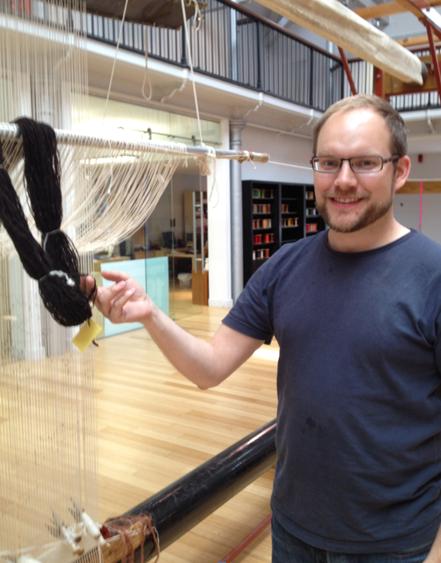
This particular tapestry is entirely composed of undyed British wool. It has proved relatively difficult to source, Jonathan admits, as it is a case of finding sheep of the right colour. Most of the wool comes from the Shetlands, although some has been taken from the royal sheep at Highgrove Estate, Prince Charles’ country home, and some from fleeces hand-spun in the Borders. The sheep farmer who took over Jenny’s farm after her death has even donated some black wool from her current flock. There is something wonderfully poetic about the different wools from sheep across the UK coming together to be woven into this effigy to a sheep farmer. The materials themselves have stories of their own.


Jonathan and some of the dark wool sourced from Jenny's old sheep farm

The Crow tapestry is being carried out by master weavers David Cochrane and Naomi Robertson. When collaborating on a tapestry, as Jonathan explains, it is very important to have a good understanding of how the image is to be interpreted, in order to work coherently together. The transition of a design to tapestry is far from mechanical and depends greatly on the individual’s decisions throughout the process. The design is traced and enlarged into a full-scale linear ‘cartoon’, which is pressed up against the warps, or vertical threads, for a basic imprinted outline. As Dovecot Studios very rarely give direction to their weavers regarding colour, this simple line drawing is the only guide available to the weavers and all of the colour mixing is done by eye, producing works that are ‘more responsive, richer and more sensitive’. If a fault is identified, or a change is to be made, the entire line has to picked out and restarted from that point. ‘Weavers learn quickly not to make mistakes through the process!’ Jonathan laughs.

The tapestries can take months to complete, and can become a big part of the weaver’s life during that time. The studio has developed something of a ceremony for the moment of cutting the finished piece from the loom: ‘we even use gold-coloured scissors…you want to mark it in some way’.

Between them, Dovecot Studios’ master weavers David and Naomi have accumulated around forty years of experience. Does Jonathan see himself continuing for a similar length of time? He smiles: ‘every project is new, each poses a new challenge’. Weaving the Century is testament to the extraordinary variety of works produced and viewers are given a chance to see what tapestry is capable of. A stunning exhibition that cannot be missed, it should be part of any trip to the Edinburgh Art Festival this summer.

Weaving the Century: Tapestry from Dovecot Studios 1912-2012 runs until 7th October 2012.


Whitworth Tapestry [1967-8] Eduardo Paolozzi


After Benches 1973 [1973] Tom Phillips

BCK 75 (Proem) [1998] Ian Hamilton Finlay